Sunday, December 23, 2007

Holiday Roundup

Flame out - Tracy Press
City of debt shows US housing woe - BBC News
2007: A look back in business, and a peek at the future - Stockton Record
Mortgage meltdown has analysts on edge - Modesto Bee
Year in Manteca marked by foreclosures, Iraq war Mantecas year that was - Tri-Valley Herald
Homes tax economy: Shasta County faces jobless increase, sales shortfall - Record Searchlight
Foreclosures hit home - Appeal Democrat
~~~
Behind the Meltdown: Six local lenders who rarely said no - Sacramento Bee
Builder's Demise Threatens Homeowners (video) - News10
Home Front: Troubled sellers get tax break - Sacramento Bee
New homes sit, wait - Stockton Record
Homebuilding stuck in doldrums here and throughout the state - Merced Sun-Star
~~~
Behind the Meltdown: Lincoln's boom fades out - Sacramento Bee
Things were good – except for the meltdown - Stockton Record
2007 was the year of the real estate bust - Merced Sun-Star
~~~
Blame abounds for housing bust - The Washington Times
Prudential California Reality Closes Tracy Office - Tracy Press
~~~
Dunmore brothers face lawsuits, alleged defaults - Sacramento Business Journal
Eleven Cars Vandalized In West Sacramento - Fox40
~~~
Risk & Rewards: Taste of hard times Once-thriving restaurants now face business slump fueled by housing market crisis - Sacramento Bee
Alliance Title Workers Face Grim Holiday - News10
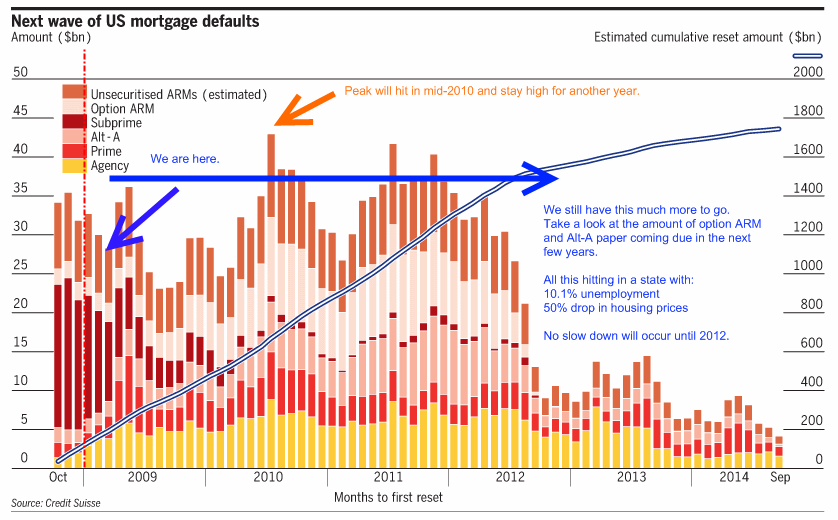
Option ARMs: Next Weakling - Wall Street Journal
Median home price here down 18% in a year - Sacramento Business Journal
Upturn in Yolo home sales - Daily Democrat
Climb Aboard the Bus! - ABCNews
Y-S jobless rate climbs near 10 percent - Appeal Democrat

Friday, December 21, 2007

Sacramento Real Estate Market - December 2007 Water Cooler

Blogging will be spotty over the next two weeks. Post links, stories, and observations here. Please read the comment policy before posting.

Sacramento Job Growth At Lowest Level Since 1993

From the Sacramento Bee:

[EDD labor market consultant David] Lyons said it was disturbing that the region has added just 6,600 jobs in the past year, a growth rate of just 0.7 percent. "We haven't been below 1 percent since 1993," he said. Unemployment has risen 1 percentage point in Sacramento in the past year. With housing still suffering and state government likely to slow down its hiring in the face of an estimated $14 billion budget deficit, the short-term outlook for Sacramento is spotty at best.
From the Sacramento Business Journal:
Year-over-year, construction fell by 7,200 jobs in the region, a 10.1 percent decline, while financial jobs declined by 3,100, off 4.7 percent. Those declines were steeper here than in the state as a whole. Statewide, construction was off 3.8 percent, down 35,400 jobs, while finance fell 1.9 percent, or 18,200 jobs.
From the Sacramento Bee:
As a long hard year of layoffs draws to an end for Sacramento-area home builders, Irvine-based MBK Homes has joined the club. A company spokeswoman says an unspecified number of cuts were made recently to "right-size" the Sacramento operation. MBK, a division of the Japanese trading firm Mitsui & Co. Ltd., and a prominent builder in Southern California, arrived in the capital region at the height of the housing boom in 2005 and began building during the slump that followed.
From the Stockton Record:
Job losses from the housing-market slowdown in San Joaquin County will slow job growth from 1.3 percent in 2006 to 0.4 percent this year, said the new fourth-quarter economic report from University of the Pacific's Business Forecasting Center.
...
Despite substantial fallout from housing and sectors tied to it, job growth overall has only been moderated, said Sean Snaith, director of University of Central Florida's Institute for Economic Competitiveness and consultant to University of the Pacific's Business Forecasting Center. "We haven't seen the wholesale spreading of the housing doom and gloom into the other sectors," he said.
...
Joe Anfuso, president and chief executive officer of Stockton-based Florsheim Homes, said most of the construction cuts already made may be all that's needed to adjust to the slowdown unless the market makes a sharp decline. "I would be surprised if most builders of substance haven't let go of 40 percent of their people since the downturn started," he said.
From the Sacramento Bee:
In Sacramento County...13.4 percent of November sales were for homes priced below $200,000, the Sacramento Association of Realtors reported. That's up from 9.5 percent in September. Homes selling for less than $250,000 represented 30 percent of November's closings, statistics indicated. "We never dreamed we'd see that again," said Mark Welch, executive manager of Connect Financial Services in Roseville.
...
DataQuick reported that in November 2,503 homes closed escrow – 26 more than the previous month – in Amador, El Dorado, Nevada, Placer, Sacramento, Sutter, Yolo and Yuba counties. That's an 11-year low for a November...The firm attributed much of the November rise to a jump in closings of new homes, 744 compared to 656 in October. That may reflect builder discounts and sales promotions in late summer and early fall. In September, for instance, New Jersey-based K. Hovnanian Homes reported 47 sales one weekend while offering area buyers fully furnished homes.
...
Home builders like to clear inventory off their books before the year ends. Last year they reported a late surge of December sales. But "there's no indication of an upward trend" this year, said Jane Enger, analyst with the Ryness Co., a home builder consultant in Danville.
Sales/Price Data by Zip

From the Modesto Bee:
Stanislaus' median home sales price plunged 23 percent this November compared with last November [and 28% from peak], according to DataQuick Information Systems. That was the steepest decline in California, at least among the counties with large populations...San Joaquin median sales prices dropped to $329,500 in November from a year ago, a 21.7 percent decline.

Thursday, December 20, 2007

Placer Popluation Growth At Lowest Level Since 1971

From the Sacramento Bee:

A few years ago, Placer and El Dorado counties were red hot, flush with Bay Area transplants and drawing more residents each year at a tremendous rate. Now that trend is cooling. Both counties grew at a slower pace in the past fiscal year than during any of the previous 35 years, according to population estimates released Wednesday by the California Department of Finance... Placer County hasn't seen a lower rate of population growth since 1971, according to state figures. And El Dorado's hasn't been this low since 1968.
...
The driver for the change appeared to be a statewide drop in domestic migration – movement from one part of the country to another. Instead, all of California's growth this year came from natural increase – more births than deaths – and immigration from other countries.
...
Changes in the housing market help explain the domestic migration trend, several experts said. With housing prices down everywhere, Bay Area bargain hunters may not have the equity to move or may be able to afford something closer to home.
...
Then there are the foreclosures. California residents who have lost their homes, [California's chief economist, Howard] Roth said, are opting to move out of state. In all, about 90,000 more people left California than came here from another state this year, and Roth said that trend may be cause for concern. When more residents leave than arrive, he said, it "often relates to what people think of California. Our economy is slowing down. We had a pretty big housing bubble that burst."
From the Sacramento Bee:
Rising construction costs and rapid growth have prompted Roseville elected officials to increase two developer fees and establish a new one, despite the sluggish housing market....City Manager W. Craig Robinson said cost pressures are affecting the city's ability to build promised facilities, many of which are needed to serve new development.
...
Building industry representatives, however, say the fee increases come at a bad time. "During this downturn, and probably for the foreseeable 18 months ahead of us, we think the market will continue to decline," said K. Hovnanian Homes' Frances Knight. "We suspect that the projections on building permits are going to be worse than estimated currently."
...
Wendy Gerig, Roseville Chamber of Commerce's chief executive officer, asked the council to delay the fee increases until the economy picks up. This year, a record number of businesses dropped their chamber membership because they folded or had financial constraints, Gerig told the council.
From the Sacramento Bee:
A recent Rancho Cordova forum, organized by Councilman Ken Cooley, drew about 80 people to City Hall to hear presentations by nonprofit organizations on options for those who miss mortgage payments and state and federal officials on what options they have to stave off foreclosure.
...
Past advice has gone out the window since the subprime collapse,...[Mike Himes, homeownership services director at NeighborWorks, a national nonprofit] said. Two years ago, the idea was to get into a house as fast as possible and eventually refinance the loan, he said. "Did anyone know two years ago there'd be a crash in the market?" Himes asked.
From the Stockton Record:
Stockton remained on top, with one foreclosure filing for every 99 households - more than six times the national average. Modesto had the No. 2 spot, with one foreclosure filing for every 104 households, and Merced took the No. 3 spot, with one foreclosure filing for every 106 households.
...
Steve Carrigan, Stockton's economic development director, said he doesn't see a downswing in foreclosures coming any time soon to the Stockton area. "It's bad, and it's going to get worse," he said. "We're going to have to weather this."

Weston Ranch Realty owner and broker Steve Clark said he hasn't seen any signs that the foreclosure scene is improving. A lot of people still come into his office hoping to list their houses in hopes of selling to avoid foreclosure, he said. Typically, though, they owe at least $100,000 more on the house than they could get for it, he said. "We can't list it," he said he tells them. "Nobody will buy your home and help you out of this mess."

There have been hardly any sales all this year, anyway, he said, adding that his office mainly handles property management for rental homes - an active scene. "I don't see a change any time soon," Clark said. "It's terrible, and I have a hard time seeing where the silver lining is."

DataQuick: Sacramento's Median Home Price Falls 18.3%

From the Sacramento Bee:

Sacramento County, where median sales prices of new and existing homes combined are now 18.3 percent below this time last year, is still California's hardest-hit urban county for declining values.
...
Sacramento County's median sales price for existing homes fell to $285,000 from $295,000 the previous month. That's down 24 percent from the August 2005 peak of $374,000 and lowest since $275,000 in April 2004.

Wednesday, December 19, 2007

'Right Into the Belly of the Beast'

From the Sacramento Bee:

STOCKTON – Weeks after unveiling a relief plan for struggling subprime borrowers, U.S. Treasury Secretary Henry Paulson came to the epicenter of the nation's foreclosure troubles to tout the effort as a "market solution" that would be fixed if it falls short.
...
Paulson promised to investigate the claim of one borrower who said her lender had refused to offer any solutions and would not talk with her until she had defaulted. "In June I'm staring down the barrel of an $8,000-a-month mortgage payment," said the woman, who declined to give her name. "From what I hear, our program is made for you," Paulson told her.
...
Paulson's visit highlighted the growing troubles of borrowers in the San Joaquin and Sacramento valleys, which accounted for almost 28 percent of California's foreclosures in July, August and September, according to DataQuick. The area has about 17 percent of the state's population. The vast 400-mile region between Bakersfield and Redding is home this year to more than 42,000 mortgage defaults from January through September, DataQuick reported...[Stockton's] unsold housing inventory is so large it would take 25 months to sell all the houses on the market today, according to Sacramento-based TrendGraphix.
From the LA Times:
The governor and Paulson on Tuesday went "right into the belly of the beast" because "Stockton is one of the hardest-hit places in the country for foreclosures," said Paul Leonard, director of the California office of the Center for Responsible Lending, an advocacy group for borrowers.
...
John Knight, a professor of finance and real estate at the Eberhardt School of Business at the University of the Pacific in Stockton, cautioned that the rush to help people who can't afford to pay more than their teaser rates needs to be tempered with fairness to other people who have been paying the higher rates all along. "What about the borrowers who borrowed responsibly and can deal with the rise in the rates?" Knight asked. "They are not getting any help, while those who borrowed recklessly are getting help."
...
"This crisis is not going to last," the governor said. "It's a bump in the road." He predicted that California's declining home values would turn upward again soon.
From Reuters:
At the Quail Lakes Baptist Church in Stockton, California, the parishioners at weekly prayer group meetings seek spiritual support for everything from health issues to marital problems to job losses.

These days, many people also are praying about their mortgages. "There are many people in this community who are losing their homes or in danger of losing their homes, and there are some who have just seen their mortgage payments go through the roof," said the Rev. Marc Maffucci, the church's pastor.

Stockton, a city about 80 miles east of San Francisco that was founded as a gateway for gold miners in the mid-1800s, has one of the highest foreclosure rates of any large U.S. metropolitan area as its once-hot housing market has gone cold.
...
[A]t Quail Lakes church in Stockton, Maffucci said that the housing crisis continues to reverberate. Some in his community are in danger of default, and others who worked in the housing industry and now are jobless. He said that at almost every Wednesday morning prayer session he attends there are requests for prayers for someone struggling with issues such as how to scrape together a loan payment.

He has provided counsel to some of his better-off congregants who got overextended in real estate and now are working to pare back their lifestyles. For others who have gotten behind on their mortgage bills, though, there is little that can be done. "I think they understand their options are somewhat limited. They are going to make the payments or they are not," he said. "They are really praying for wisdom at that point."
From the Stockton Record:
The motto of Campbell-based Alliance Title Co. was "Closing the California Dream." Its informal motto late last week became: "Closing Our Doors." The company unexpectedly went out of business, shutting down San Joaquin County offices in Stockton, Lathrop, Manteca, Tracy and Lodi, reportedly costing about 30 people their jobs.
...
Jerry Abbott, president and co-owner of the Stockton real estate firm Coldwell Banker Grupe...said the closure news was quite a surprise. Alliance Title representatives even sat in on his real estate firm's sales meeting last Wednesday. "They never said a word," he said.

Ben Balsbaugh, residential sales manager for PMZ Real Estate in Stockton, said everybody knew a shutdown was inevitable. "There were certainly red flags," he said. "For the past couple of years, we kept hearing about all the high salaries and bonuses they were paying out to their escrow officers." He said he just didn't see how Alliance could have sustained that in the slow market, he said. "There was not enough business."
From the Stockton Record:
Years of growth in property tax revenue appears to be grinding to a halt as the dismal housing market and mortgage crisis have started leeching money from public coffers.
...
The fat years of the housing boom saw the assessed value of all property in the county grow by more than 17 percent just two years ago and by 9 percent this year, according to the San Joaquin County Assessor's Office. But growth in revenue next fiscal year, which begins July 1, will be minimal, at best, and some areas could even see a decline, said Assessor Gary Freeman. Freeman sent a memo at the end of November to county officials to give them an early warning about such a drastic shift, he said.
From the Sacramento Bee (hat tip Sacramento Crash):
Valerie Harris had an errand to run before she could pay for the work done on her husband's classic hot rod. She had to rob a bank, authorities say. Wearing gold-rimmed reading glasses and carrying a cowboy-style pistol with a wooden grip in her purse, the 50-year-old Rocklin woman walked up to a teller at the US Bank inside a Safeway grocery store in Roseville last Wednesday and handed him a note demanding $10,000, according to court papers filed in federal court Tuesday.
...
At that moment, authorities say, Harris transformed from quiet suburbanite to the person later dubbed the "Grandma Bandit."...Harris, 50, was driven to rob the bank of $1,243 in small bills because of mounting economic hardships – including what authorities said was the recent foreclosure on the home she and her husband have lived in the past nine years, according to the criminal complaint.

Monday, December 17, 2007

"Loans to Sacramento Trailer-Home Buyers...Trigger a Global Credit Crisis"

From the Toronto Star (hat tip Tyrone):

Anatomy of a credit crunch
Who would have thought questionable loans to Sacramento trailer-home buyers could someday trigger a global credit crisis


The current calamity arises from a systemic failure over, of all things, home mortgages – one of the most dead-simple financial transactions in existence. When the housing bubble was gaining altitude, lenders, regulators, debt-rating agencies, buyers of bundled mortgages and central bankers couldn't imagine that questionable loans to Sacramento trailer-home buyers could someday trigger a global credit crisis.
From the Sacramento Bee:
Even in a region with more than 7,600 foreclosures in just the first 10 months of the year, no place has been hit as hard as Western Avenue in North Sacramento. On the block where Marshall lives, 16 of 45 homes have been foreclosed in 2007 – more than on any other block in the four-county region, according to a Sacramento Bee analysis of thousands of foreclosure records...Of the 16 homes foreclosed on the street's hardest hit block, at least 13 had been bought with adjustable rate mortgages, according to a Bee review of property records.
...
But, by several accounts, Western Avenue was getting better when multiple new homeowners – most carrying expensive subprime loans given to borrowers with shaky credit – moved into the neighborhood during the past three years. They were chasing bargains and believing the hype about everyone being able to own a home.

Now, with the collapse of the housing market and the plunge of home values, Western Avenue's best chance to escape its past appears to have come – and gone. "This is like a Third World country," says Michael Davis, who grew up in the neighborhood and lives in a rented house on the street.
...
Jack Poe is among the few who has seen opportunity in Western's crisis. The ATM repairman and his sister were able to buy half a duplex from US Bank a month ago for $86,000, well below the $125,000 to $200,000 prices similar homes on the street were going for just a few years ago. Poe got a taste of reality right from the start: Someone stole the air conditioner from his new place while it was vacant. "We don't have a lot of neighbors right now," says Poe, 47, who formerly lived in a rented house in Rancho Cordova. But he's upbeat about having 800 square feet of his own now. "It's finally nice to say, 'I've got a home.' "
...
Tony Brisbane, a caretaker for Coldwell Banker Real Estate..is in charge of trying to keep three houses on Western clean and free of squatters. He oversees more than 50 such properties in the region...He is not optimistic about where things are headed. "It's going to grow," he says. "It's going to get worse."
From the Sacramento Business Journal:
Warren Adams, a broker with Security Pacific Real Estate, has been selling REO property for 20 years and has watched the industry shift. When the real estate market was in a frenzy, most foreclosures were older homes in tougher neighborhoods. During those times, the majority of REO brokers sold to home investors who preferred a low price to a home in good condition. The investor added value by doing the work. "A few years ago, we could sell those all day long to investors," he said.

But things have changed. Such a flood of REO is hitting the market that there aren't enough investors to buy the homes. That means REO brokers are now primarily marketing to people who are actually going to live in the home, which means a home's condition takes on more significance, Adams said. "The banks are realizing that the target buyer now is an owner-occupied buyer, and the homes have to be move-in ready for those people," Adams said.
...
One key job for an REO broker is putting the right value on a home. They send the lender "broker's price opinions" on the market value of a home. Typically, they offer a timeline with that opinion for 90 days, 120 days and 180 days on the market. In a regular market, the shorter term is the lowest price; prices usually go up when a broker has more time to market and show a home. But now that calculation isn't working, [Ron] Leis [co-owner of Diez & Leis Real Estate Group] said. These days, the longer-term price is actually lower, with perhaps a 10 percent discount on the value for a home at 180 days versus the present value.
...
What got the real estate market to this point was a lot of misdirection from lenders and mortgage companies trying to make a sale during the run-up in housing prices, said Robert Dillon, a broker with Security Pacific Real Estate. "I'd get people who earn $12 an hour telling me they qualified for a $300,000 loan," Dillon said. "I warned people against that kind of loan."
From the Sacramento Business Journal:
Last month, Dann Ingrim, co-manager of Lyon Real Estate's downtown Sacramento office, went to market confidently with a 985-square-foot, three-bedroom house priced in the low $400,000s. It sold in three days at full price. Sacramento is bearing the brunt of what some are calling the worst housing slump since the Great Depression, and houses three times that size have been sitting on the market for half a year. But this home is located in East Sacramento, one of the city's venerable neighborhoods along with others such as midtown, Land Park and Curtis Park that have in many ways resisted the ravages of the housing downturn.
...
[T]he price per square foot for homes in core areas has been historically much higher than suburban areas, often about $300 or more according to TrendGraphix....While that figure has leveled off or declined slightly for core neighborhoods, the decline has been much sharper in the suburbs. In Elk Grove, the price per square foot is approaching half what it is in core neighborhoods -- a disparity that's only growing wider as the slump rolls on.
...
Despite the resilience of the core neighborhoods, they're not immune. Just as in Sacramento as a whole, the inventory of homes for sale in core neighborhoods has crept up over the past two years. Gone are the days when two or three offers was the guaranteed response after a home had been listed for a week, [Coldwell Banker agent Polly] Sanders said.
From the Sacramento Bee:
[R]ecently announced plans by the federal government and the state of California to save some of them in the name of saving the economy are provoking protests from people who say they've played by the rules. Their rallying cry is personal responsibility and living within your means.
...
A homeowner for 33 years, Ron Loutzenhiser opposes a mortgage bailout of subprime and other borrowers and pronounced himself "infuriated" by a recent spate of "tear jerker" Bee stories about people in foreclosure. Dozens of others said the same in calls, e-mails and reader comments on the newspaper's Web site.
...
Proposals to modify global financial contracts to bring short-term relief to U.S. borrowers risk long-term damage by sparking enduring uncertainty in the mortgage system, he said. "For the greater good, you're talking not just about the immediate future of these borrowers, but the future of their sons and daughters," [Steven] Sheffrin [economist and dean of the division of social sciences at the University of California, Davis] said. "It's really about a small set of today's homeowners against a whole future set of homeowners."

Talk to someone waiting to buy a home, and you'll see what Sheffrin is talking about. They're offended the government is stepping in. They worry that a bailout will artificially prop up home prices that have been fast falling in their direction. "There's a lot of us waiting on the sidelines for prices to come down to an affordable level, says Chris Stafford, 34, a commercial insurance broker in Sacramento. "A lot of us were priced out of this market."
...
"We saved our money while our friends and co-workers bragged about how much equity they just cashed out to buy their new boats and cars," says a recent post on The Bee's Web site. "Now while they're on the verge of losing everything we are preparing to buy our first home next year. … Life lesson: Live within your means."
From News10:
Salvation Army Capt. John Brackenbury...said donations stuffed in the organization's familiar red kettles are off by $36,000 in Sacramento County when compared to this same time last year. Nancy Richards, is manning the Salvation Army's toy donation desk inside the Arden Fair Mall. "Hardly anybody's buying," Richards said. "This is the worst I've seen it in 15 years." She blames high gas prices and the sagging housing market. "Because of the foreclosures and stuff, people can't afford to buy. They're losing their homes. They're just buying what they can for themselves," Richards said.
From the Sacramento Business Journal:
Investors will likely find favorable real estate deals next year -- if sellers are willing to bargain -- in land, apartment complexes and office buildings around Sacramento, according to a market forecast from the region's top brokerage, CB Richard Ellis. The discount is courtesy of the severe housing downturn and the global credit crunch, which have pushed values down for all kinds of non-housing assets.
...
Land values are plunging, and broker William Ayres expects the same in 2008. So far, owners have been reluctant to deal, holding out hope that their once-skyrocketing values will return as the housing crisis passes. But not all of them will be able to stand pat and will be forced to sell to cover debt on their holdings.
...
"It is troubling that we have 2.5 million square feet under construction with another 6 million vacant," [office specialist Greg] Levi said of the overall downtown market. "That's an eight- to 10-year supply."
...
CB Richard Ellis 2008 predictions: Average home prices will drop well below $300,000 before stabilizing.
From the Modesto Bee:
The cost to secure and maintain a neglected home here for a year? Nearly $3,000 by the [Manteca] police chief's tally. This city, hit hard by the housing market downturn and upsurge in foreclosures, passed strict requirements last month to keep up appearances at vacant houses. Owners, some of which are banks, are responsible for neatly boarding up windows to keep out squatters and for maintaining the front yard. Those who don't, risk getting a bill from the city for the work. Today, Police Chief Charlie Halford is scheduled to ask the City Council to allocate $102,725 for landscaping and boarding up about 35 houses. That amount is what it would cost to fix up and maintain for a year, 5 percent of the estimated 700 residences in the city in some stage of being repossessed.
From the Modesto Bee:
Another foreclosure record was set in November as 1,336 properties were offered to the highest bidder on the courthouse steps in Modesto, Merced and Stockton. Now here's the real surprise: Only 17 of them sold, despite lenders offering deeply discounted prices.
...
On Friday, [ForeclosureRadar owner Sean] O'Toole said, a foreclosed five-bedroom Modesto home on Hemstead Avenue went up for auction with a starting bid of $301,500, even though the lender was owed $537,000 from a delinquent mortgage. But that $235,500 discount apparently wasn't enough. O'Toole said no one bid, so the lender now owns the house.
From the Stockton Record:
Existing home sales in San Joaquin County rose last month from October, making it the second consecutive monthly increase in a season when sales usually fall off...The median sales price also slid last month to $310,000, down 20 percent from $388,000 a year ago.
...
The majority of sales and pending sales reportedly are foreclosure houses, more than 2,000 of which have piled into the residential market since just the beginning of the year. Brokers and agents said that those foreclosures are clogging up the market and most of the demand for traditional resale homes as would-be buyers watch prices slide. "Every sale counts," said Jerry Abbott, president and co-owner of Coldwell Banker Grupe, Stockton. "I still think September was the bottom of the sales market."

Friday, December 14, 2007

'Dead Market' Kills Alliance Title

From the Modesto Bee:

Alliance Title Co. went out of business, laid off all its employees and closed its doors Thursday. At least 30 employees in Stanislaus County, plus hundreds more elsewhere in the state, lost their jobs with less than one day's notice.
...
Terry Harwell, division president for Alliance in Stanislaus County...said he was shocked to hear his four offices -- three in Modesto and one in Turlock -- were being closed and that he and everyone else was being let go. "We're the market-share leader in Stanislaus County, so it didn't seem viable that they would close us down," Harwell said. "We were on pace to break even this month."
...
In 2005, at the peak of the real estate buying and refinancing boom, Alliance had more than 200 offices and about 2,500 employees in California, Harwell said. That included 10 branches and about 165 employees in Stanislaus County. "Two years ago, we made a ton of money," said Harwell, noting that Alliance raked in $370 million that year.

Then the housing market began crashing, and Alliance started slashing staff. Harwell closed six Stanislaus County offices and eliminated more than 100 jobs this year. He also closed six branches in Merced and Fresno counties. About 14 employees in a Lathrop title service center were let go Thursday...[E]scrow transactions dropped dramatically the last two years. In August 2006, Alliance processed 715 transactions in Stanislaus County, but that declined to 348 in August 2007.

From the Redding Record Searchlight (hat tip Suzanne):
Fredericka Martin of Real Estate 1 in Redding, who worked in the title insurance industry for 25 years before becoming a real estate agent, speculated that the housing slowdown had little to do with Alliance Title closing. "Normally with a big company, if they are having problems, somebody will buy them," Martin said. "When they just close the doors, something went bad and I have no idea."
...
But Bob Martin of Summit Mortgage in Red Bluff said the chilled housing market had everything to do with Alliance Title's demise. "More people are losing their homes. ... We are in the worst real estate market in 20 years," Martin said. "A title company has to sell title insurance policies to stay alive. It's the lack of business; it's a dead market."
From the Modesto Bee:
Staggering and bleary-eyed from yet another "inevitable" growth binge hangover, valley residents are still trying to assess the costs of their latest housing boom. One effect is in the form of a new kind of eyesore -- "brownies," abandoned houses where the yards and gardens have died and the lights are either never on or never off. But things might be even worse than they look.

In Modesto, the City Council is struggling to manage yet another budget shortfall. The solutions are likely to include a reduction in the number of police and fire positions -- this in a city routinely ranked among the highest in the nation for such crimes as auto theft.
From the L.A. Land blog:
The relatively new foreclosure auction tracking service ForeclosureRadar reports that banks and lenders are starting to offer discounts on foreclosed homes at the initial auctions, with discounts running as high as 42% of what is owed on the house...Example: A Stockton home with an underlying foreclosed loan of $419,000 was recently auctioned with an opening bid of $240,000 -- a discount of 42.8% from the bank's investment -- and still attracted no bids, [Sean] O'Toole says.
Sacbee.com has a poll on the mortage rate freeze plan. Vote here.

Thursday, December 13, 2007

"The Deep Pockets...Are Suddenly Empty"

From the Sacramento Bee:

There's a grinch in town this year, emptying the Christmas stockings of poor children and taking the food off family tables. But the culprit isn't a green fellow whose heart is two sizes too small – Sacramento's villain has no heart at all. It's the weak economy, Virginia, and it has the people who run holiday toy and food drives panicky as needs grow and donations dwindle.
...
It's a common refrain, said Steve Heath, president of United Way/California Capital Region. "I'm hearing the same thing everywhere – it's a tough year for getting food and for getting toys," Heath said. "Part of it is the local economy. Anyone who works in the housing industry is struggling....

In the Sacramento region, the deep pockets of some philanthropic developers are suddenly empty. "Developers are going through very challenging times," said David Hosley, general manager of public television station KVIE. "Some that were very generous to us in the past can't be this year. This is what I said to one of them last week: 'Listen. We remember what you've done. We know where your heart is. And this year we understand that you can't do it.' "
From the LA Times (hat tip LA Land):
[N]obody doubts that Stockton and the rest of the Central Valley have been severely jolted. By October, foreclosures in Stockton's San Joaquin County were more than eight times last year's levels, outpacing the state's increase by 41%, according to DataQuick, a La Jolla-based information service...[S]peculators -- an estimated 40% of the home buyers in Stockton -- were buying houses in order to flip them quickly at a nice profit.
...
Pete Ponce de Leon, a 50-year-old machinist, said he and his wife were barely keeping up with their monthly mortgage payments, which shot up from $1,700 a year ago to $2,500 now. He said he cashed in two IRAs, sold his tools, sold a truck and was bracing for another rate increase this month. Along the way, he lost his job, and his lender refused to cut him a break. "Why don't they just screw us all at once instead of a little at a time?" said Ponce de Leon, who has found another job and hopes to renegotiate his mortgage.

Asked whether the higher payments took them by surprise, Ponce de Leon struck the same note as many other homeowners in trouble. "We just thought we'd be OK," he said, explaining that he and his wife had planned to use what they'd expected to be the rising equity in their home to refinance the adjustable loan at a lower rate.
...
Monaliza Botello, a 25-year-old nurse, said she was surprised when her father, who brings in $4,500 a month, last year secured a loan requiring a $4,000 monthly payment. The idea was that Monaliza's father would own the new $495,000 four-bedroom for a year or two, at which point she and her husband, Isaac, could afford to buy it from him with a refinanced loan. But the three of them, who were all living there, fell behind in their payments, and Monaliza lost her dream home...As home prices plunged, Botello's cousin around the corner also went into foreclosure, as did her godmother -- a real estate agent nearby. "Everyone was going, 'We can't refi? How can we afford this?' " she said. "Everyone was just shocked."
From CNBC's Realty Check:
I’m hearing some disconcerting rumblings from some builders, anecdotally speaking of course. One mid-sized private builder told a friend of mine that potential customers coming through their model-home doors are openly hostile. They’re not just looking for good deals; they’re looking for payback.

Apparently some of today’s new homebuyers blame the builders outright for the current housing predicament. They are telling unwitting sales reps that they are to blame for running up prices and foisting untenable loans on clients during the latest housing boom. Buyers are telling the sales people stories of how rudely they were treated during the boom, how they were told that if they didn’t want to take the deal they could stick it, because there was a line of buyers right behind them.
From the San Diego Union-Tribune:
Joseph Anfuso, a USD alumnus who served as chief financial officer for Shea Homes in San Diego before becoming president of Florsheim Homes in the Central Valley, said that when prospective buyers come window shopping at a development, “treat them like a rich grandfather, as if you're in the will.”
From the North County Times:
"The one thing I can tell about you Realtors is that you're all liars," said Joseph Anfuso, president of Florsheim Homes, a builder in California's Central Valley. Anfuso told agents during a Wednesday real estate conference at the University of San Diego that they need to stop inflating or hiding sales numbers and swallow a hard dose of reality on their cash flow if they expect to remain in business as sales continue to plummet.

Wednesday, December 12, 2007

'The hype about the housing market is running out of gas'

From Inman News:

Tamara Dawn, a real estate broker in Sacramento, Calif., compiled statistics for Sacramento County which show that REO sales and short sales -- which are sales of homes in which the sale price falls short of what the homeowner still owes on the mortgage -- accounted for about 26.3 percent of total sales in the county from May 7 through Nov. 7.

A short sale can assist a homeowner in avoiding foreclosure and can be less costly for a lender than taking ownership of the property. Short-sale transactions can take more effort and time than typical real estate transactions, as they typically require extensive paperwork and can take weeks to receive a decision back from the lender on whether to approve or reject the terms of the sale.

REOs alone accounted for 22.5 percent of total sales in Sacramento County during the May 7-Nov. 7 period, and REO sales accounted for 35.8 percent of total sales in the county from Oct. 7 through Nov. 7.

As of Nov. 7, about 52.7 percent of all pending sales for the previous 30 days in Sacramento County were related to short-sale and REO transactions, while about 46.6 percent of all active listings on Nov. 7 involved short-sale and REO properties.
From the Sacramento Bee:
Hopes for an office tower and high-rise housing at Eighth and I streets downtown have been dashed again. The CIM Group, a Hollywood-based developer, has opted out of its plans to buy the parcel, raze the existing building and build a new one, says Rob Leonard, economic development director for Sacramento County, which owns the site. CIM's move follows a similar decision last year by Texas home builder D.R. Horton to abandon its plans for a 21-story "Library Lofts" project at the same site.

Leonard says CIM's decision was a "sign of the (weakening real estate) market" and an indication that CIM is focusing on other local projects, including a joint venture with CalPERS at the former John Saca high-rise condo site at Third and Capitol Mall.
From the Stockton Record:
A couple of top bidders in a no-minimum-bid auction of foreclosed homes nearly a month ago in Stockton are not only unhappy that banks didn't accept their bids or even negotiate a sale, they haven't gotten back thousands of dollars in deposits. "It was a waste of my time," said Lewis Stallworth Jr., a Stockton man who put in a top bid of $135,000 for a north Stockton house. "I feel like it was almost a scam. There's no use in going to an auction if they're going to act like that."
...
"I'm kind of sorry I got into this, to tell you the truth," [Mel] Schell said. "It's been way too long." Miller said the auction deceptively implied most bids would be accepted. Plus, several weeks after the auction is too long not to hear anything, she said. "It seems like sort of a fiasco," she said.
...
Dave Webb, a Hudson & Marshall partner, said...typically, either deals are to be made within 30 days, or deposits are returned quickly enough....But some of the large banks or asset managers don't move quickly, Webb said.
From the Redding Record Searchlight (hat tip Suzanne):
The nation's largest savings and loan closed its Redding office on Hemsted Drive on Monday. Washington Mutual's home loan center in Redding had four employees. One will be retained by the company, spokesman Greg Kischner said Tuesday. The company also closed its home loan centers in Chico and Yuba City, which had 11 employees between them, four of whom will stay on with Washington Mutual.
...
This is at least the second reported home loan business in Redding to close since September. National City Mortgage, also citing woes in the housing market, closed Sept. 26. The Churn Creek Road office had five employees.
...
In Shasta County, Benchmark Real Estate Mortgage, First Mortgage Corp., Frost Financial Mortgage, Santa Cruz Mortgage and Mission Hills Mortgage have closed.
From the Anderson Valley Post (hat tip Suzanne):
The Vineyards housing development in Anderson has lain relatively dormant for several months. The plan by developer Sanderson Communities entails 2,500 acres to contain 5,500 units in the hills behind Wal-Mart on Rhonda Road. No construction that requires building inspections has been done at The Vineyards since July.
...
Roger White, vice president of development at Sanderson Communities...said that houses on 95 lots would be ready for construction by March, but only a few houses would actually be built until the housing market improves. “The hype about the housing market is running out of gas,” White said. “People are still having babies and are still interested in this area.”
From the LA Times:
Gov. Arnold Schwarzenegger told social service advocates Tuesday that the state's anticipated budget shortfall -- already feared to be the worst since he took office -- has widened to $14 billion, according to people at the meetings.

That new figure indicates that the state's fiscal fortunes are declining even more rapidly than many leaders had expected. Less than a month ago, the Legislature's chief budget analyst calculated that California is on track to come up $10 billion short by June 2009, when the state ends its next fiscal year.

A $14-billion budget gap would translate to more than 12% of the state's budget if spending continues to rise as projected. Legislative Analyst Elizabeth Hill last month urged legislators to consider getting rid of state programs created in recent years, abolishing tax breaks, raising taxes and reducing benefits for the recipients of government programs.

Tuesday, December 11, 2007

The Housing Boom's "Scorched-Earth Retreat"

From News10 (and video):

Sources told News10 Alliance Title Company is shutting down operations in the Sacramento area effective immediately. At one time, Alliance was the number one title company in Sacramento based on market share according to one longtime employee...One employee who was laid off Monday said she was told there's not enough work to continue supporting office operations. "I've never seen it this bad," she said.
From the San Jose Mercury News:
Washington Mutual, battling to extricate itself from a worsening mortgage quagmire, said Monday that it will chop 3,150 jobs, close nearly 200 home loan offices, shut call centers and double provisions for loan losses. The reeling bank will shut four home loan centers and one call processing center in the East Bay, three home loan centers in San Joaquin County and one home loan center in Solano County, a bank spokesman said...Among the local shutdowns, the bank revealed that it will close: Home loan centers in downtown Oakland, Dublin, Pleasant Hill,Lafayette, Stockton (two are being closed in that city), Manteca and Fairfield.
From the Modesto Bee:
Hiring in Stanislaus and Merced counties after the new year is expected to be more lethargic than last year, with less than one-fifth of employers projected to add jobs, according to a survey released today. Twenty percent of companies surveyed in the region said they expect to reduce employment in the three-month period starting in January, and 17 percent said they will add jobs, according to the quarterly Manpower Employment Outlook Survey.
...
[Cezanne] Mills said she started seeing some changes in hiring patterns in mid-2007, mostly in the financial sector tied to the housing market. Several mortgage and title companies either closed or scaled back their operations. "A lot of people with good skills were laid off because their company closed," said Mills, who estimates about 50 percent of the people who respond to Manpower job listings in Modesto used to work in the mortgage industry.
From the Christian Science Monitor:
Pushing up against almond groves and dirt-bike trails, the row of homes on St. Salazar Circle marks the furthest advance of Modesto's housing boom – and the start of its scorched-earth retreat. Brown, unwatered lawns of foreclosed homes compete with the green grass of neighbors still hanging on. Some of the structures, although new, are missing outdoor equipment like air conditioners, taken by metal thieves. One in 4 houses of the neighborhood stands empty, and mortgage defaults are certain to push even more residents, mostly Hispanic immigrants, out of their homes.
...
In the city made famous by the movie American Graffiti, the crisis is unfolding geographically. On its fringes, new neighborhoods, like the one surrounding St. Salazar Circle, the home-loan crisis has hit the hardest. Built during the height of the housing boom, they have the newest residents who paid the highest prices with the most exotic mortgages. After seeing prices rise 10 to 20 percent each year, they're now seeing prices slide downward.

"Right now, our dreams are being crushed," says Marisol Ramirez, a wife and mother of three who bought a home on St. Salazar last year for $370,000. Now, it's priced at $300,000 and the Ramirezes are likely to lose it. Their troubles began when their home was robbed, something that grew common in the neighborhood with the lack of work and the empty homes. That sent their insurance rates higher. Then her husband lost his job in home construction: No one is building these days. They haven't made a mortgage payment in three months on their 40-year, no-money-down loan. Now they are weighing whether to rent around Modesto or just return to Mexico.
...
Each day at the stroke of noon, Dean Roots arrives at the courthouse steps to read the 40 or so new homes put on the block....For months now, no more than a half-dozen onlookers have turned out for the ritual. On most days, no one even bids. "I try not to think about it because a lot of these people have brought it on themselves," Ms. Roots says.

Monday, December 10, 2007

Industry 'Laying Off Long-Time Employees Right and Left'

From pacificunionhomes.com (hat tip reader HS):

As I am sure you are aware, we all are experiencing a major downturn in our industry. These adverse conditions in the market have forced us to re-evaluate the Company’s future as a homebuilder. Accordingly, Pacific Union Homes has made the decision to cease further homebuilding operations. We will continue to build-out and sell those homes currently in production, including the model homes.

Pacific Union Homes is a diversified real estate company, with homebuilding being only one of its many operations. Although, the Company has decided to no longer operate as a production homebuilder, we will continue to focus on land development and our other real estate-related businesses. [Read more]

From the Lodi News Sentinel:
Real estate, lending, appraisal and title company offices have laid off employees and closed offices during the housing slump. "They're laying off long-time employees right and left," said Lodi Realtor Rose Mendonca.
...
Earlier this year, Chicago Title Co. closed its Lodi office and consolidated with the Fidelity National Title Co., and four employees have lost their jobs, according to Renee Primasing, a marketing representative at the Fidelity office on Kettleman Lane. That leaves four in Lodi's Fidelity office. And in Galt, Alliance Title Co. will close its doors in the near future, with two employees being transferred to the Greenhaven office off Interstate 5 in south Sacramento. Alliance's Elk Grove office has already closed, according to employees in the Galt and Sacramento offices who asked to not be identified.
...
Stockton-based Grupe Co. has suffered with their new-home market, said CEO Kevin Huber...[who] estimates that 20 Grupe employees have been laid off in the past year....
From the Associated Press:
Plenty of locally owned stores are facing a struggle. In California's San Joaquin Valley, Christina Perret said the foundering housing market has caused sales to sag at her three high-end women's fashion clothing shops and forced her to reconsider her stock. Perret's gotten rid of racks of flashy tops with plunging necklines that were favorites with real estate agents, substituting a line of conservative sweaters popular with farmers' wives. "We're going after the wives of dairymen and women in agriculture because their economy is so much more stable," said Perret, 25. "Even moms who come in shopping with their daughters for prom aren't wanting to spend as much now. They want to buy dresses for $200 max and know their daughters can wear it at graduation next year."
From the Stockton Record:
A decline in money transfers and increased reverse migration is expected due to the troubled housing market and the lack of construction jobs, said Jose Rodriguez, director of El Concilio (Counsel for the Spanish Speaking).

"The construction industry has taken a hit. It's a ripple effect for them," Rodriguez. Also, he said, homeowners are cutting back expenses such as landscaping and other services. That's a problem since a vast number of immigrants work in the service industry.
From the Stockton Record:
The auction of 61 foreclosure homes in San Joaquin County last month resulted in the sale of two out of three of the homes offered in no-minimum bidding in Stockton...Typically, more than 90 percent of top auction bids are accepted by highly motivated banks...."Banks may not have a complete understanding of the Stockton market yet, so expectations may be above what's happening in the market," she [a spokeswoman for Hudson & Marshall] said.
...
Another agent with a half-dozen listings in the auction, Cindy Mello of Home Buyers Realty, Stockton, said not one of the bids for her listings was accepted or negotiated to a sale. "It says the auction doesn't work, that it's a marketing ploy," she said. "I don't think the banks are ready to negotiate yet."
From the Sacramento Bee:
C.C. Myers, the contractor whose road-building exploits have become the stuff of California legend, said Friday he is working to stave off foreclosure on his Auburn area country club development. Wachovia Bank, in a 23-page complaint filed Wednesday in U.S. District Court in Sacramento, alleged that Myers has defaulted on more than $61 million in loans and is seeking to foreclose on the 1,100-acre Winchester Country Club.
From KCRA:
From News10:
As recently as last spring, Myers told a construction trade magazine that despite the housing slowdown in other areas, Winchester continued to see "solid demand" for high-end homes.
From the Sun-Post:
Two Manteca housing developers that purchased the right to build homes in town in 2005 persuaded the City Council this week to let them hold on to that right until 2010, hoping that the housing market will turn around by then. Developers Marvin Brochinni and Atherton Woodward Partners had originally promised the city they would give up reservations for any homes they failed to build within two years. However, plummeting property values and a glut of unsold homes in the city have upended both developers’ subdivision plans, and they now hope that waiting a couple of years will help get their projects back on track.
From the Redding Record Searchlight:
In September, I reported that the worst might be over for real estate in Redding -- cautious optimism stemming from a second-quarter federal housing index.

Maybe not.

In its latest index, the Office of Federal Housing Enterprise Oversight (OFHEO) says home prices in Redding in the third quarter of 2007 were 3.66 percent lower than in the same quarter a year ago and 2.54 percent lower than the second quarter of this year.

Friday, December 07, 2007

200 Implosions

The Implode-O-Meter hits 200

'Would you ruin the economy just to be moral?'

From the Sacramento Bee:

Almost from the start when struggling Dunmore Homes announced in September it was selling its assets to a loan consultant, rumors started in the home building industry that the deal involved an unconventional sales price and had something to do with a big tax refund. The gossip was on the money. The newly sold company filed for Chapter 11 bankruptcy protection in November. Now, documents filed in U.S. Bankruptcy Court in New York show that Sid Dunmore sold his Granite Bay firm to Sacramento-based loan consultant Michael Kane for $500. And there is an expectation that Sid Dunmore will receive an $11.2 million federal tax refund from selling the company his late father founded in 1953.
From the Wall Street Journal's Developments blog:
Median household income in the Sacramento metropolitan area, measured earlier in 2007 by the American Communities Survey, is $56,950. Realistically, if you don’t want to spend more than 33% of your take-home pay on a mortgage and you earn the median, you should pay no more than about $1,570 towards your mortgage and taxes. That caps your mortgage loan at $240,000 (which still leaves you a modest $150 a month to put toward taxes) at a 5.85% interest rate (this week’s going rate for a 30-year fixed). But the median single-family home price in the third quarter was $375,400 in Sacramento. That’s a $135,000 gap. What’s more, the median income to sales price ratio balloons to 6.6 in this equation. There’s nothing affordable about that.

You’d need to have a median income of at least $70,000 — or nearly 25% more than the median — and a 20% down payment to buy the same home in the Sacramento area. This situation plays out in dozens of pockets of the country every day, even as housing prices soften.
From the Modesto Bee:
Levitz is the second Northern San Joaquin Valley home retail store to announce this week that it's closing. On Tuesday, the owners of Youngdale's, a Turlock store that specialized in home appliances, announced they would close within the next month.
From the Redding Record Searchlight (hat tip Suzanne):
Chalk up another casualty to the housing slowdown. 84 Lumber closed its Redding store Wednesday after less than five years in business. The store catered to professional contractors and had five employees.
From the Sacramento Bee:
Q: Will this give a lift to the Sacramento-area real estate market?

A: ...Carey Covey, a Sacramento real estate agent who sells homes repossessed by banks, had one word when asked if the Bush plan will help here: "No." Covey's opinion: "There is a very small percentage of people who are going to be eligible."

Alan Wagner, president-elect of the Sacramento Association of Realtors, worries that borrowers with good credit who got in over their heads still account for more area foreclosures than subprime borrowers. Still, he called the move a "step in the right direction."

Q: Is this a bailout for irresponsible borrowers who took out loans they couldn't afford?

A: There are many who believe that's the case. Bush argued Thursday that no taxpayer funds are involved in this initiative. But many who bought their homes by saving their money, using down payments and getting fixed-rate loans believe a new generation of careless buyers is being rewarded for being foolish.

Lincoln retiree Steven Smith sums up the argument: "My wife and I drive 10-year-old cars, have zero credit card debt, and when we put new flooring in the house, we paid cash. That's what you do. You don't habitually live beyond your means and expect to have a good outcome."

Others, however, contend many borrowers were duped by mortgage lenders who took advantage of their inexperience. They say loan agents inflated their incomes on their applications without their knowledge and told them not to worry: They could refinance into a better loan when the value of their house appreciated – as it certainly would.
From the LA Times:
Ed Skebe of Manhattan Beach would agree that even if some people were duped by shady mortgage brokers or loan officers, many knew they couldn't afford the homes they bought and rolled the dice anyway in hopes that the boom had enough life left to shower them with profits. "They hurt everyone. They drove the prices up," said Skebe, a 61-year-old program manager at an air-freight company, who said the booming housing market prevented him from trading up to a larger home. "It's hard for me to believe that someone didn't realize they couldn't afford a $600,000 home."
From the Vacaville Reporter:
Tim Kearns, owner of Fairfield-based First Priority Financial, said he's seen more adjustable rate mortgages written in the past few years than were necessary. He believes that while the relief plan will help some property owners, it may hurt the housing market overall. "The backlash is that lenders and investors alike will likely be much more skittish about investing in adjustable rate loans in the future," he said.
...
The average client doesn't go into foreclosure because they don't understand their loan, according to Kearns. "Most people had an assumption that the future was going to be better. They knew the loan would get a lot more pricey. But they thought that would be OK, because hey, real estate always goes up in value. And that's the misnomer they were told."
From the Washington Post:
The agreement has sparked bitterness and anger among those who either sat out the housing boom or endured friends' snickers when they stuck with a traditional mortgage and a smaller house. To some who watched prices rise out of their reach or who moved to cheaper cities, the agreement looks like a penalty for those who didn't gamble. "What about those of us who played by the rules? Can we get six months of free gasoline? Isn't there something for the rest of us?" asked Tim MacKinnon.
From the SF Chronicle:
Despite the fact that the value of his 1955 bungalow has fallen $50,000 to $75,000 from its peak two years ago, Sacramento resident Gene Totten would rather see the housing market correct itself further on its own than see the government step in to halt the freefall. "When you're buying a house, it's a big deal, a big decision, and you need to read the fine print and know what you're getting yourself into," said Totten, an operations manager at a construction company. "I wouldn't consider myself a fiscal conservative politically, but this is tinkering with the free market."
...
GU Krueger, economist with Irvine's IHP Capital Partners, one of the nation's largest investors in residential development,...brushed aside concerns that the plan rewards irresponsible behavior by both lenders and borrowers. "Now's not the time to be prudent. It's too late for that," he said. "We're all morally outraged over what's happening. But would you ruin the economy just to be moral? What's the point in that?"

Thursday, December 06, 2007

'A Housing Recession Like None Ever Imagined or Experienced'

From Reuters:

Housing markets from Punta Gorda, Florida, to Stockton, California, will crash and suffer price drops of more than 30 percent before the housing crisis is over, a report from Moody's Economy.com said on Thursday...Punta Gorda, Florida, and Stockton, California, are the hardest hit markets in the U.S., with price declines from peak-to-trough forecast at 35.3 percent and 31.6 percent, respectively.
...
These markets have been hard hit due to several reasons, namely the exiting of investors from the areas, a fair amount of subprime mortgage loans causing an increase in foreclosures and overbuilding by home builders, Zandi told Reuters.
Moody's past predictions for Stockton home prices:
  • -25% (September 2007)
  • -16% (October 2006)
As of October, the median home price in the city of Stockton had dropped 31.4% from peak, according to TrendGraphix. San Joauqin County's median was down 25%.

From Reuters:

    There is a "substantial" risk that U.S. home prices will slide for the next three years or more, in a downturn that could be unlike anything seen before on a national level, Morgan Stanley said on Thursday in a report. Price levels of the RPX Index, a derivative index based on home prices in 25 U.S. metropolitan residential property markets [including Sacramento], indicate an expectation that prices will decline for the next three years, with a recovery likely to occur between three and four years from now, Morgan Stanley said.

    "The property derivatives market seems to be suggesting that we are in a very different environment, on the heels of market events that could force a housing recession like none ever imagined or experienced," Morgan Stanley analysts said.

    Wednesday, December 05, 2007

    "HillaryCare For Housing"

    From the Sacramento Bee [updated link]:

    The Elk Grove Unified School District may experience declining enrollment next year, said Richard Odegaard, the district's chief financial officer, at Tuesday night's board meeting..."It looks like we might have a double whammy: a declining enrollment district with declining state funds," Odegaard said.
    ...
    [Updated] School officials, who sounded the warning bell at Tuesday night's board meeting, blame the housing slump for the potential decline – the district's first since it formed in 1959. "It's the first time anyone of us can remember 'declining enrollment' being in our vocabulary in this district," board member Priscilla Cox said Tuesday.
    From the Modesto Bee:
    While the economy sputters along amid falling home prices, higher unemployment and tight credit, one sector of retail is reporting a surge in consumer interest. Employees at thrift stores and secondhand shops say they're seeing more customers these days, as the regular bargain hunters are joined by people who have become more cost conscious.
    ...
    Bob Van Hoffwegen, store manager of Priceless Treasures thrift store in Modesto, says he noticed an uptick in business that has mirrored the surge in home foreclosures and the drop in home sales. "There's been quite a rise since midsummer," Van Hoffwegen said of the store....
    From the Stockton Record:
    Joe Anfuso, president and chief executive officer of Stockton-based Florsheim Homes, said that although lower interest rates will be a positive force when the residential market settles down, they aren't affecting the new home-sales market at all now. Actually, pricing isn't either, he said. It's "buyers' psychology," which continues to be negative about home buying so long as prices continue to drop, he said. "It's really more the fear of: If I'm buying today, are prices going down tomorrow?" Anfuso said. "There's no sense of urgency."
    From the Irvine Housing Blog (hat tip patrick.net):
    Once the pool of buyers is exhausted and the volume of buying declines, prices stop rising, and the belief in future price increases diminishes. When the remaining potential buyers no longer believe in future price increases, the primary motivating factor to purchase is eliminated; Prices fall. The temporary rise and fall of asset prices is the defining characteristic of a bubble.
    From National Review:
    If you thought Hillary Clinton’s government takeover plan for health care was bad, wait ‘til you see what she has in store for the housing sector. As always with the Clintons, the market is the problem and Big Nanny is the solution. Unfortunately for taxpayers, Hillary has bipartisan company in the Bush administration on this issue. Their election season prescription? Rewarding bad behavior. Punishing responsible behavior. Doing more harm than good.
    ...
    Instead of letting lenders and subprime mortgage-holders suffer the consequences of their actions, politicians and grievance-mongers are riding to the supposed rescue. In a supreme irony, the very same champions of the needy in the Democrat party who complain constantly about the lack of “affordable housing” are now fighting tooth and nail to keep housing prices high.
    ...
    Fiscal conservatives ought to be balking at HillaryCare for housing. But President Bush’s treasury secretary, Hank Paulson, is singing a similar tune...Lawmakers on both sides of the aisle are colluding to protect the reckless and keep home prices high on the backs of prudent taxpayers. Who’ll bail us out from this perversion of the American Dream?
    From the L.A. Land blog:
    A poll by the LATimes and Bloomberg reports that 58% of those surveyed say sub-prime lenders should freeze interest rates for sub-prime borrowers.

    Tuesday, December 04, 2007

    'We really just need to let it wash through'

    A look at Sacramento real estate market numbers for November:

    From the Wall Street Journal:
    A government-led plan to freeze interest rates on certain troubled subprime home loans drew criticism both from investors who foresee losses and from some analysts warning that it will merely prolong the pain of the mortgage crisis...Alan Fournier, a fund manager at Pennant Capital Management LLC, Chatham, N.J., predicted that the plan being pushed by the Treasury Department will prolong the pain of the housing slump. He said it would merely delay inevitable foreclosures for some people who can't afford their homes, while allowing holders of mortgage-backed securities to put off marking down their assets. "This reduces the pressure short-term to bring everything to a clearing price," Mr. Fournier says. "We really just need to let it wash through."
    From the New York Times:
    The Bush administration’s effort to help at least some people in danger of defaulting on their subprime mortgages could affect only a small share of those who took out such loans during the final two years of the housing bubble, industry analysts said today. Though administration officials have yet to agree on crucial details with mortgage lenders and the securities industry, a broadly similar effort by the state of California is likely to help only about 12 percent of borrowers in the state with adjustable-rate subprime loans, according to estimates by Barclays Research.
    Average Buyer posts some suggestions for dealing with the housing mess.

    Monday, December 03, 2007

    'I just wish we never would have bought'

    In conjunction with the article linked below, the Sacramento Bee has posted an interactive map which shows foreclosures that have occurred over the last 13 months in the Sacramento region.

    From the Sacramento Bee:

    For more than 7,600 households across the region, the lights of home have gone out this year. Months after their foreclosure proceedings ended, they are scattered to new neighborhoods and to other towns. They are a harbinger of what's to come as the region's mortgage crisis spills into 2008.
    ...
    As the turmoil mounts, assigning blame or asking why almost seems beside the point. People are losing houses for every reason you can imagine. They got sick and lost jobs. People got adjustable-rate mortgages with initial low interest rates that then reset to a higher rate, causing payments to soar out of reach. Mortgage brokers fraudulently sold them loans they didn't understand and couldn't afford. Many who bought early in the boom recklessly spent their equity gains and couldn't make their refinance payments.
    ...
    "I just wanted to own a home," says Andrea Eddy, 27, a former state worker in Sacramento who lives in Trinity County now, a four-hour drive from the capital. "I thought everything was perfect with my husband and our jobs and our daughter, and that a house was the next step." A year after losing her new light-brown two-story home at Southport's Huckleberry Circle, she says, "I just wish we never would have bought."
    From the Stockton Record (hat tip Tyrone):
    When Jenny and Ricardo Hernandez bought their north Stockton home in 2005, their monthly mortgage payments were around $1,800. Now the payments total nearly $3,000 - more than the working couple's monthly net income - and the Hernandez family is facing almost inevitable foreclosure. Jenny Hernandez, 36, was just one of around 500 people who lined up Saturday at Stockton Arena for an informational workshop in the hope they might stave off foreclosure on their homes or improve their financing in a troubled mortgage market.
    From the Central Valley Business Times:
    [T]here may be little the government can do to bail out those faced with losing their homes as the interest rates on their mortgages goes up, says state Sen. Mike Machado, D-Linden, chairman of the state Senate’s banking and finance committee. “A mortgage is a contract and that contract in many cases has been bundled and has been sold away from the local bank or institution that issued the contract,” says Mr. Machado.

    “It has become part of a securitized product that is now being marketed worldwide,” he says. “By coming in and by law trying to change a contract will send ripples … to the investment market in terms of the confidence investors will have in products that would be coming from the mortgage marketplace in the future.”
    From ABC 7 (hat tip Jeff):
    When it comes to the mortgage crisis, it's hard to find the bright side. But for a very few, the misfortune of others has been a financial boon. A nightmare for so many, the mortgage crisis has unlocked new business opportunities for at least a few people in East Contra Costa County. That's where changing locks on homes like this that have gone into foreclosure, has become a bit of a windfall for Joe Grant, the owner of "Poppa Joe's Lock & Key."
    From the Associated Press: (hat tip Diggin Deeper)
    Echoing the complaints of consumer advocates who have long pushed for mortgage lending reform, Robert Toll, chief executive of luxury homebuilder Toll Brothers Inc., said stronger restraints are needed to prevent a recurrence of today's problems. "We had mortgages available to the alive and standing and that was the only criteria," he said. "There's no reason why we can't set limits." Toll also said home prices "may not have stopped falling yet," adding that it may not "be the best time to buy a home."

    Mark Zandi, chief economist at Moody's Economy.com, predicted that, if the economy slips into recession or if efforts to modify loans don't pick up substantially, the housing market downturn could last through the end of the decade. "This is the most serious housing downturn since the Great Depression," Zandi said.

    Saturday, December 01, 2007

    Housing Tracker: Median Asking Price Drops 19.2%


    Source: Housing Tracker

    Radar Logic: Sacramento Real Estate Places Dead Last Again

    From the Sacramento Business Journal:

    The average price per square foot of homes sold in the Sacramento metropolitan area fell nearly 15 percent in a year, the biggest drop among 25 major national markets tracked by Radar Logic Inc., the New York-based real estate analyst reported Friday.
    The Sacramento real estate market has ended up in last place for three consecutive months, beating out markets such as San Diego, Las Vegas, and Tampa. Sacramento also claimed the bottom spot for condo price appreciation for the third month running, with prices plunging 21.5% compared with the prior year.

    Radar Logic September Report [pdf]